

Last Updated: October 25, 2026
Quick Summary
To achieve buttercream stiff piping consistency, use a ratio of 1 part softened butter to 3 to 3.5 parts sifted powdered sugar, with 1 to 2 tablespoons milk and 1 teaspoon vanilla. Chill for 10 to 30 minutes depending on room temperature, then test with the peak method, the peak should stand straight up without curling or drooping.
- Use 1 pound butter, 3 to 3.5 pounds powdered sugar, 2 to 4 tablespoons milk, and 2 teaspoons vanilla for a standard batch.
- Sift powdered sugar before measuring to remove lumps and ensure even incorporation.
- Test consistency by dipping a spatula into frosting and pulling straight up; the peak should stand straight without curling or drooping.
- Chill buttercream for 10 to 15 minutes in cool kitchens or 20 to 30 minutes in warm kitchens above 75 degrees.
- Add 1 tablespoon sifted powdered sugar at a time to thicken, or 1 teaspoon milk to soften, mixing on low speed between adjustments.
Table of Contents
- Why Buttercream Consistency Matters for Piping
- The Ideal Ingredient Ratio for Stiff Buttercream
- How to Thicken Buttercream Frosting Step by Step
- Buttercream Consistency for Piping Different Decorations
- How Long to Chill Buttercream Before Piping
- Buttercream Piping Tips and Common Mistakes
- Get Your Piping Supplies Ready
- Frequently Asked Questions
Why Buttercream Consistency Matters for Piping
Mastering buttercream stiff piping is the foundation of professional-looking decorations. If your frosting is too soft, it won't hold its shape. If it's too thick, it'll be impossible to squeeze through a piping bag.
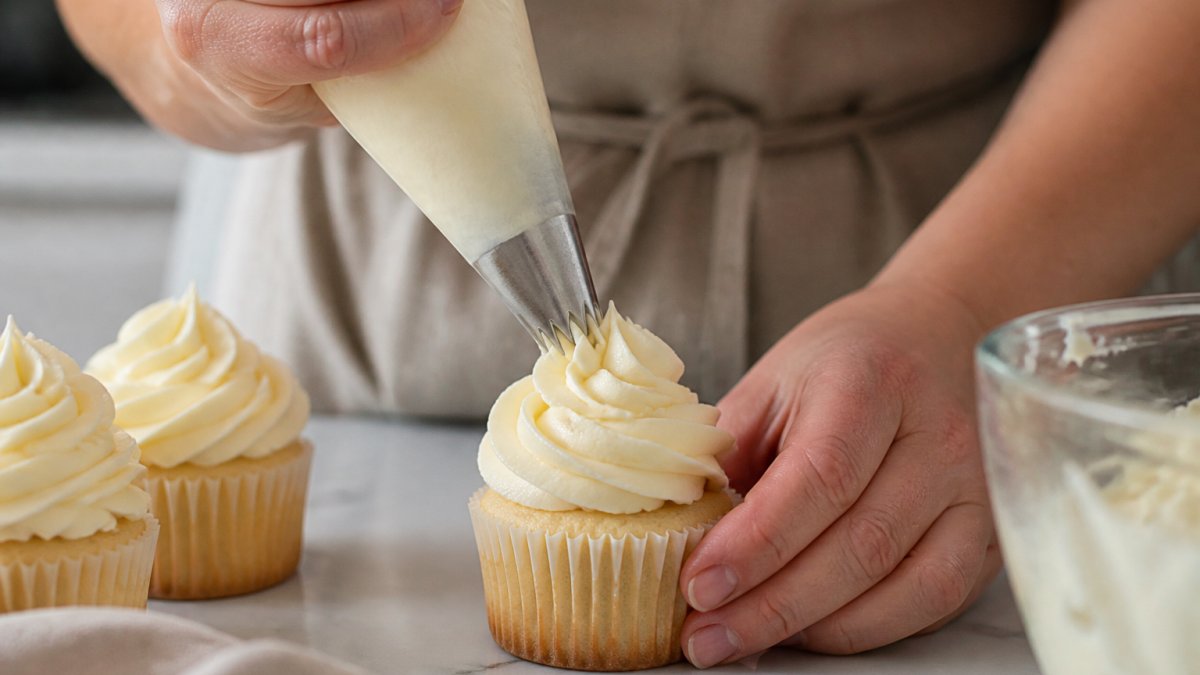
Many bakers skip this step and wonder why their piping looks sloppy. The difference between mediocre and beautiful decorations often comes down to this single detail: buttercream consistency. When your frosting has the right texture, piping becomes easier. Your hands don't have to work as hard.
Think of consistency as the backbone of cake decorating. You can have the fanciest piping tips in the world, but without proper buttercream stiff piping consistency, they won't deliver results.
The Ideal Ingredient Ratio for Stiff Buttercream
The foundation of stiff buttercream is a repeatable ratio, not a guess. Most American buttercream recipes use butter, powdered sugar, milk or cream, and vanilla, but the proportions determine whether the frosting pipes cleanly or slumps. A dependable starting ratio by weight is:
- 1 part softened butter (8 ounces / 2 sticks)
- 3 to 3.5 parts sifted powdered sugar (24 to 28 ounces)
- 0.05 to 0.1 parts milk or cream (1 to 2 tablespoons)
- 0.02 parts vanilla extract (1 teaspoon)
That translates to a standard batch of 1 pound butter, 3 to 3.5 pounds powdered sugar, 2 to 4 tablespoons milk, and 2 teaspoons vanilla. The lower end of the sugar range gives you a medium-stiff frosting for writing and borders; the higher end gives you a stiff frosting for rosettes and flowers. Start at 3 parts sugar and add the last half-pound only if the peak test fails.
Why the ratio works: Powdered sugar provides structure, its starch and fine crystals absorb water and fat, creating a network that holds air. Butter provides fat and aeration; too much butter relative to sugar and the frosting stays soft.
Scaling the ratio: The ratio scales linearly by weight. For a half batch, use 8 ounces butter, 12 to 14 ounces powdered sugar, 1 to 2 tablespoons milk, and 1 teaspoon vanilla.
Adjusting for climate and kitchen temperature: In a warm kitchen (above 75°F), use the higher end of the sugar range and the lower end of the liquid range.
Sifting matters: Unsifted powdered sugar contains lumps that create a grainy texture and uneven stiffness. You can purchase pre-made buttercream frosting as an alternative to making it from scratch.
How to Thicken Buttercream Frosting Step by Step
If your buttercream is too soft, you have several options. The method you choose depends on what went wrong.
If your frosting is goopy:
Start by chilling it. Place your bowl in the refrigerator for 15 to 20 minutes. Cold buttercream firms up naturally. This is often the fastest fix.
If chilling doesn't help enough, add more powdered sugar. Sift it first, then add one tablespoon at a time while mixing on low speed.
If your frosting is too soft from excess liquid:
You added too much milk or cream. The fix is to add more powdered sugar to balance it out. Again, add gradually.
If your frosting broke or looks curdled:
This usually means the butter and liquid separated. Bring the bowl to room temperature and let it sit for a few minutes.
Watch out: overmixing can turn your buttercream grainy and separate. Mix only as much as needed to reach the right consistency.
Buttercream Consistency for Piping Different Decorations
Different decorations need different stiffness, and the fastest way to get consistent results is to test your buttercream against the task before you fill a bag. Use these observable tests, each takes under a minute, to match consistency to the decoration. Mastering these structural adjustments provides a reliable foundation for your decorating, much like the precision required to bake consistent cookies when you move from the piping bag to the oven.
For stars, swirls, and rosettes (stiff consistency):
- Peak test: Dip a spatula into the frosting and pull it straight up. The peak should stand straight up without curling or drooping. If it curls, the frosting is medium-stiff; if it droops, it's medium.
- Piping test: Pipe one star on a plate. It should hold a sharp ridge and a defined point for at least 30 seconds without slumping. If the point rounds off, add 1 tablespoon sifted powdered sugar and retest.
- Detail retention: Pipe a small rosette and check after 1 minute. The ridges should still be visible and the shape should not spread. The Wilton Open Star 1M Tip is a good test tip because its wide openings show slumping quickly.
For writing and fine lines (medium-stiff consistency):

- Peak test: The peak should curl slightly at the top, like a soft-serve ice cream curl, rather than stand straight or droop.
- Line test: Pipe a 2-inch line on a plate. It should hold its width without spreading and release cleanly from the tip when you stop squeezing. If the line spreads, the frosting is too soft; if it breaks or skips, it's too stiff.
- Tip test: Use a small round tip (Wilton #3 or #4). If you have to squeeze hard enough that your hand tires after a few letters, thin with 1 teaspoon milk and retest.
For smooth, flat frosting like a crumb coat (medium consistency):
- Peak test: The peak should droop over within a few seconds.
- Spread test: A spatula should glide across the surface with light pressure, leaving a smooth trail that settles slowly. If the frosting drags or tears, it's too stiff; if it runs, it's too soft.
For piping flowers (stiff to medium-stiff, depending on petal type):
- Petal test: Pipe one petal on a flower nail. It should hold its edge and not collapse when you add the next petal. For roses, use stiff consistency so petals stand; for ruffled flowers, medium-stiff lets petals curve naturally.
- Release test: The frosting should release from the petal tip cleanly. If it strings or clings, it's too stiff, add 1 teaspoon milk.
| Decoration Type | Consistency Level | Peak Appearance | Pass/Fail Test |
|---|---|---|---|
| Stars, swirls, rosettes | Stiff | Stiff peak stands straight up | Piped star holds sharp ridge for 30 seconds |
| Writing, fine lines | Medium-stiff | Peak curls slightly at top | 2-inch line holds width and releases cleanly |
| Smooth spreading | Medium | Peak droops over | Spatula glides and trail settles slowly |
| Piping flowers | Stiff to medium-stiff | Straight to slight curl | Petal holds edge when next petal is added |
If your buttercream passes the test for one task but fails for another, adjust in small increments: 1 tablespoon sifted powdered sugar to stiffen, 1 teaspoon milk to soften. Mix on low speed for 10 seconds between adjustments so you don't incorporate air. Re-test after each change, most frostings need no more than two adjustments.
How Long to Chill Buttercream Before Piping
Chilling time depends on your room temperature and how soft your frosting is. If it's already at the right consistency, you may not need to chill it at all.
If your buttercream is slightly soft, chill it for 10 to 15 minutes. Check the consistency and chill longer if needed.
In warm kitchens (above 75 degrees), chill for 20 to 30 minutes before piping. Warm air softens buttercream quickly, so you may need to re-chill between batches of piping.
Never chill buttercream longer than necessary. Over-chilled frosting becomes too hard to pipe. It'll crack in your piping bag or come out in chunks instead of smooth lines.
A helpful tip: chill your piping bag and tips too. Cold tools keep buttercream firm longer while you work. This is especially useful if you're decorating multiple cakes or cupcakes in a warm environment.
Buttercream Piping Tips and Common Mistakes
The most common mistake is using room-temperature butter. If your butter is too warm or too soft, your buttercream will never reach stiff consistency.
Another frequent error is not sifting powdered sugar. Lumps create texture problems that no amount of mixing can fix. Spend the extra 30 seconds to sift. It makes a real difference.
Many decorators overmix their buttercream. More mixing doesn't mean better results. Mix on low to medium speed only until ingredients are combined. High-speed mixing incorporates too much air, creating a grainy, separated frosting.
Using the wrong liquid is another issue. Whole milk works better than water. Cream creates an even richer, stiffer frosting. Some decorators add a tablespoon of meringue powder or cornstarch to their buttercream for extra stability.
Get Your Piping Supplies Ready
Once your buttercream reaches the right consistency, you need the right tools to pipe it. Quality piping bags and tips make the work easier and produce better results.
Wilton 12" Disposable Decorating Bags are a practical choice for most home decorators. They're affordable, easy to handle, and come in convenient packs.
For larger decorations or when you want more control, Wilton 16" Disposable Decorating Bags hold more frosting and work well with bigger tips.
A decorating turntable makes piping smoother and faster. You can rotate the cake toward you instead of reaching around it.
Fill your piping bag only halfway to two-thirds full. An overstuffed bag is hard to control and frosting can squeeze out the top.
Stiff buttercream that pipes beautifully doesn't happen by accident. It comes from understanding ingredient ratios, using proper technique, and taking time to chill when needed.
Frequently Asked Questions
How do you know when buttercream is stiff enough for piping?
Perform the peak test: lift your mixer beaters straight up from the buttercream. Stiff peaks should stand upright and hold their shape without drooping. For piping flowers and detailed decorations, you need stiff peaks that don't curl over at the top. If the peaks flop over, your buttercream needs more powdered sugar or less liquid. Properly stiff buttercream should feel firm but still spreadable, not grainy or overmixed.
What can I add to buttercream to make it thicker without making it too sweet?
The best option is to add more powdered sugar gradually, a tablespoon at a time, while mixing on low speed. If sweetness is already a concern, reduce the liquid (milk or cream) instead by removing a teaspoon or two and remixing. You can also chill the buttercream for 15-30 minutes, which naturally firms it up. Avoid adding flour or cornstarch, as these can create a gritty texture and change the flavor profile of your frosting.
Can I chill buttercream to make it easier to pipe?
Yes, chilling is one of the easiest ways to stiffen buttercream. Refrigerate for 15-30 minutes before piping, depending on how soft it is. If your buttercream is very soft, chill it for up to an hour. Cold buttercream holds its shape better and pipes cleaner lines and sharper details. However, chilling alone won't fix buttercream that's too soft from incorrect ingredient ratios. Use chilling as a temporary fix while you adjust your recipe for the future.
Does humidity affect buttercream consistency?
Yes, humidity significantly impacts how stiff your buttercream becomes. On humid days, buttercream tends to soften faster because it absorbs moisture from the air. If you're baking in a humid climate or season, start with slightly less milk than your recipe calls for, or add powdered sugar in smaller increments. Keep your buttercream in a cool room while piping, and consider working in an air-conditioned space during summer months to maintain consistent texture throughout your decorating session.


