

Last Updated: November 10, 2026
Quick Summary
Choose piping tips by the mark you want them to leave, not by brand or price: round tips give smooth lines for outlines and lettering, while star, petal, leaf, and drop-flower tips add texture. Then match your royal icing consistency to the tip, since stiff icing suits star and petal tips and medium icing suits round tips.
- Sketch the cookie design first, then pick the tip shape, then the size.
- A fine 00 or 0 round tip needs medium icing on the thinner side to avoid clogging.
- Beginners should start with four tips, not a 50-piece set.
- A 1 or 2 round tip gives a clean dam for outlines before flooding.
- Stay at 00, 0, or 1 round tips for lettering on a standard 3-inch cookie.
Table of Contents
- Start With Tip Shape, Not Brand
- The Best Piping Tip for Cookies Depends on the Design
- Piping Tips for Royal Icing: Match the Tip to the Consistency
- Piping Tips for Cookie Decorating for Beginners: A Minimal Starter Kit
- Royal Icing Consistency for Outlining and Flooding
- Tip Size in Practice: Measurable Examples for Line Width
- Troubleshooting Common Cookie-Piping Problems
- Build Your Cookie Tip Set at Jane's Cake and Baking Supply
- Frequently Asked Questions
Start With Tip Shape, Not Brand
Choosing the right piping tip starts with one question: what mark do you want it to leave? The opening shape of a tip, not its brand or price, decides whether you get a fine line, a star, or a petal. That single idea is the fastest way to learn how to choose piping tips for cookie decorating, and it is the approach we take with every baker who walks into Jane's Cake and Baking Supply.
Tip shape sets the result. Size only changes how big that result is.
A common mistake is buying a big set by brand name and hoping for the best. Instead, match the shape to the design first. Then pick the size.
- Round tips leave a smooth, round line
- Star tips leave ridges and texture
- Petal tips leave curved, ruffled shapes
- Leaf tips leave pointed leaf shapes
- Drop-flower tips leave simple flower shapes
- Multi-opening tips leave several lines at once
The Best Piping Tip for Cookies Depends on the Design
The best piping tip for cookies is the one that matches your design and your icing consistency, not the most expensive tip in the drawer. A fine round tip suits outlines and lettering. A star tip suits texture. A petal tip suits ruffles and flowers.
So sketch the cookie before you reach for a tip. Ask what each part needs: a crisp edge, a soft petal, or a quick dot.
Here is how the main shapes break down.
Round Tips for Outlines, Lettering, and Details
Round tips are the workhorses of cookie decorating. They leave a smooth line with no ridges, which makes them perfect for outlines, lettering, dots, and fine detail work.
Small round tips give you a fine point for writing names and drawing tiny lines. The PME "00" Supa Tube from our shop is a fine round tip, and its listing describes it as ideal for outline, lettering, dots, balls, beads, stringwork, lattice and lacework.
Use round tips for:
- Outlining a cookie before flooding
- Writing names and short messages
- Adding dots, beads, and small accents
- Drawing fine lines and details
A common mistake is using a round tip that is too large for lettering. The lines blob together. Start small and size up only if you need to.
Star, Petal, Leaf, and Drop-Flower Tips for Texture
Texture tips turn a flat cookie into something with depth. Star tips leave ridged lines, so they are great for shells, stars, and borders. Petal tips leave a curved edge, which suits ruffles and flower petals. Leaf tips leave a pointed shape for foliage, and drop-flower tips leave a simple flower in one squeeze.
Use these tips for:
- Star tips: shells, stars, and textured borders
- Petal tips: ruffles, petals, and soft folds
- Leaf tips: leaves and foliage
- Drop-flower tips: quick flowers and rosettes
If you want to add pre-made accents alongside your piped details, a set like Butterfly Silhouette Icing Decorations can save time on a busy cookie tray.

Piping Tips for Royal Icing: Match the Tip to the Consistency
Piping tips for royal icing only work when the icing consistency matches the tip. A fine round tip needs icing thin enough to flow but thick enough to hold a line.
Start by thinking in three working consistencies, then adjust for the tip you are holding.
- Stiff (holds a sharp peak): suits star, petal, and leaf tips where you want ridges and folds to stay put. Too stiff for fine round tips, where it skips and tears.
- Medium (soft peak that settles slowly): the default for round tips doing outlines, lettering, and dots. It flows through the opening but holds the line you draw.
- Thin (ribbon that disappears in a few seconds): for flooding only. It will not hold a line through any detail tip.
Here is how the pairing plays out tip by tip:
- 00 and 0 round tips: need medium icing on the thinner side. If it is too stiff, the hairline breaks into dashes; if it is too thin, the line spreads and letters lose their edges.
- 1 and 2 round tips: medium icing. This is the most forgiving pairing and the one to practice first.
- 3 and 4 round tips: medium to slightly stiff icing, because a wide line of thin icing slumps at the edges.
- Star tips: stiff icing. Soft icing lets the ridges melt back into a smooth rope within seconds.
- Petal and leaf tips: stiff to medium-stiff icing so the curve and point hold their shape as you pull away.
- Drop-flower tips: stiff icing, or the flower collapses as the tip lifts.
A quick selection flow for a single cookie: decide the finest line the design needs, pick the tip for that line, then set the icing to the consistency that tip wants.
Consistency also drives clogging.
Watch out: if your lines spread or sag, the icing is too thin for that tip. If the icing skips and tears, it is too stiff.
Piping Tips for Cookie Decorating for Beginners: A Minimal Starter Kit
A beginner does not need a giant set. You need a small, focused kit that covers outlines, texture, and flooding. That keeps your budget low and your drawer tidy.
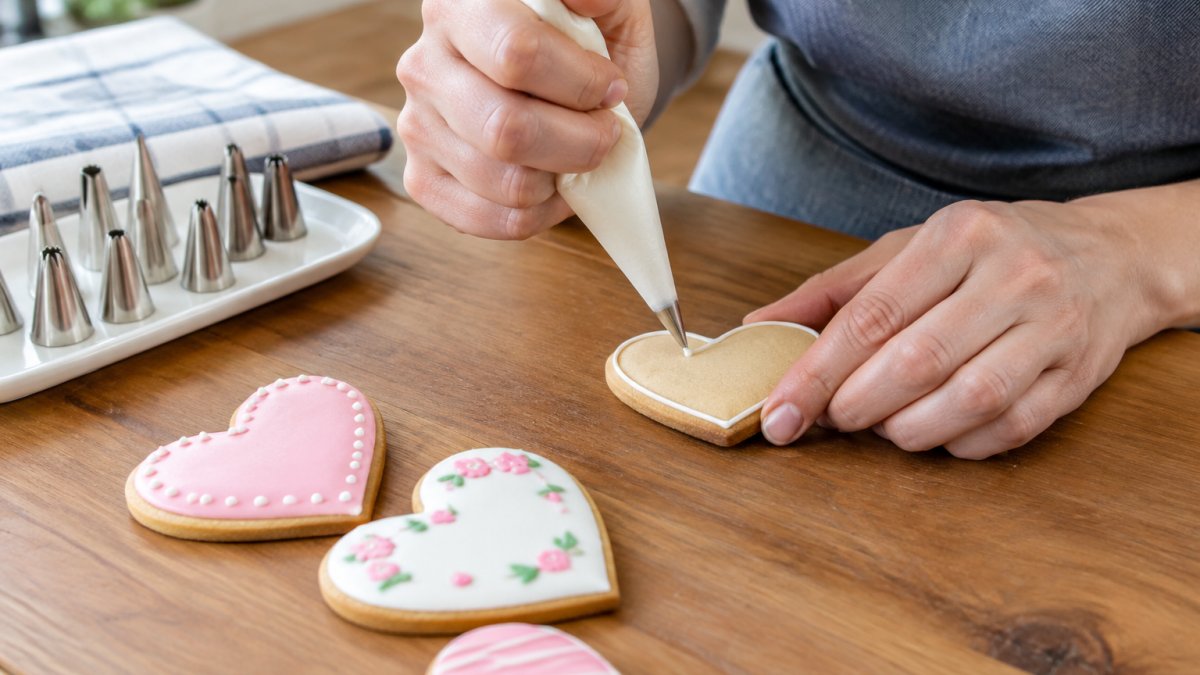
Here is the starter kit we recommend:
- One small round tip for outlines and lettering
- One medium round tip for flooding and dots
- One star tip for texture and borders
- One petal or leaf tip for flowers and foliage
- A few disposable piping bags
- A coupler so you can swap tips fast
- A small offset spatula and a scribe tool
A ready-made mix like Xo Baking Co Sugar Cookie Gourmet Mix lets you practice piping on real cookies without mixing dough from scratch. A flavor emulsion such as Princess Cake Cookie Flavor Bakery Emulsion adds variety to your practice batches.

Watch out: buying a 50-piece set before you can pipe a clean line wastes money. Start with four tips and master them first.
Royal Icing Consistency for Outlining and Flooding
Royal icing consistency for outlining and flooding is the make-or-break step. Outline icing should hold a line and not spread. Flood icing should flow smooth and settle flat.
Test the outline icing by piping a short line. It should keep its shape. Test the flood icing by drawing a line through it; it should smooth out within a few seconds.
- Outline icing: thick enough to hold a crisp edge
- Flood icing: thin enough to settle smooth
- Detail icing: stiff enough for dots and lettering
Pipe the outline first, let it set slightly, then flood inside it. This keeps the flood from running over the edge.
Tip Size in Practice: Measurable Examples for Line Width
Tip size controls line width, and line width changes the whole look of a cookie. A smaller opening gives a finer line. A larger opening gives a bolder one.
The figures below are approximate and assume medium royal icing; stiffer icing leaves a slightly narrower line, and thinner icing spreads wider.
| Round Tip (typical number) | Approx. Opening | Approx. Line Width | Best For |
|---|---|---|---|
| 00 | About 0.3 mm | Hairline, under 1 mm | Tiny lettering, fine dots, delicate stringwork |
| 0 | About 0.4 mm | About 1 mm | Small lettering, crisp outlines on small cookies |
| 1 | About 0.5 mm | About 1-1.5 mm | Standard outlines, names, small accents |
| 2 | About 0.7 mm | About 1.5-2 mm | Medium outlines, dots, simple detail |
| 3 | About 1.0 mm | About 2-2.5 mm | Bold outlines on larger cookies, beads |
| 4 | About 1.3 mm | About 2.5-3 mm | Fill work, thick borders, big dots |
A few practical rules follow from those numbers:
- Lettering: stay at 00, 0, or 1. A 2 or larger blobs letters together on a standard 3-inch cookie.
- Outlines before flooding: a 1 or 2 gives a clean dam that holds flood icing without a visible ridge.
- Dots and beads: the tip number roughly predicts the dot diameter, so a 2 makes dots about 2 mm across and a 4 makes dots about 3 mm across.
- Big cookies: a 12-inch cookie can carry a 3 or 4 outline; a 2-inch cookie cannot.
Match the line width to the size of the cookie, not to the size of your hand. A big cookie can carry a bolder line. A small cookie needs a fine one. If you are unsure, pipe a short test line on parchment and measure it against the cookie before you commit.
Troubleshooting Common Cookie-Piping Problems
Most cookie-piping problems come down to icing, pressure, or a clogged tip. Fix those three and most issues disappear.
- Lines that spread: icing too thin, or tip too large
- Lines that skip: icing too stiff, or tip clogged
- Blobs at the start: too much pressure at the beginning
- Air bubbles: icing not pressed down in the bag
- Tip clogging: a speck of dried icing in the opening
Fill the piping bag in small batches and twist the top closed. Squeeze with steady pressure, not bursts. Clean tips right after use so dried icing does not block the opening.
Build Your Cookie Tip Set at Jane's Cake and Baking Supply
Building a cookie tip set is easier when you can see and feel the tips before you buy. Jane's Cake and Baking Supply offers decorating supplies and hands-on classes for bakers of every skill level. Our PME Supa Tube tips, including the "00", "0", "1", and "2", are $5.99 each and are made from high quality seamless stainless steel.
A customer wrote: "The selection is wonderful and the staff are so helpful."
Ready to pipe cleaner lines and sharper detail? Get started with Jane's Cake and Baking Supply and build a tip set that matches your cookies, with stainless steel tips, disposable bags, and hands-on classes to guide you.
Frequently Asked Questions
What size piping tip is best for outlining cookies?
A small round tip in the 1 to 2 range is the usual starting point for outlining cookies. These tips give a narrow, controlled line that holds its shape against royal icing flooding inside it. If your outline needs to be finer, step down to a 0 or 00; for a bolder border, step up to a 2. The right size also depends on your icing consistency, so test a short line on parchment before piping a full cookie.
Do you need piping tips to decorate cookies, or can you use just a bag?
You can decorate cookies with a snipped piping bag, but tips give you repeatable results. A cut bag opening widens as you squeeze, so lines get thicker and less even. Stainless steel tips hold a fixed opening, which matters for lettering, dots, and outlines that need to match across a whole tray. For flooding only, a squeeze bottle or a bag with a small cut works fine, so tips are most valuable for detail work.
Which piping tips work best for writing and fine details on cookies?
Small round tips are the standard choice for writing and fine details. A PME 00 Supa Tube Decorating Tip, sold at Jane's Cake and Baking Supply for $5.99, is built for a precise, narrow line and works for lettering, dots, beads, and stringwork. Step up to a 0 or 1 if your icing is thicker or you want a slightly heavier line. Keep the icing at a pipeable consistency so it flows without spreading.
What is the 10-second rule for royal icing?
The 10-second rule is a quick consistency test: drag a knife or spoon through the icing and count how long the surface takes to close over. If it smooths out in about 10 seconds, it is usually right for flooding. Icing that takes much longer is better for outlining and detail work, while icing that closes almost instantly is thin and may run past your borders.


