

Last Updated: October 30, 2026
Quick Summary
To pipe buttercream flowers on a cake, use medium-stiff buttercream that holds a soft peak and pipe each bloom on a parchment-covered flower nail before sliding it onto a chilled, level cake. Build roses by layering petals from the center outward, then place the largest buttercream flowers first and fill gaps with medium blooms, small blossoms and leaves.
- Buttercream should hold a soft peak but still flow smoothly through the tip.
- A Wilton 2D tip costs $3.50 and works with a large coupler.
- Fill piping bags only two-thirds full to keep petals even.
- Piped flowers freeze for several weeks on parchment squares in a sealed container.
- Chill the arranged cake 20 to 30 minutes before transport.
Table of Contents
- Buttercream Consistency and Preparation Before You Pipe
- Best Piping Tips for Buttercream Flowers by Bloom Type
- How to Pipe Buttercream Flowers on a Flower Nail
- How to Pipe Buttercream Roses with Layered Petals
- Piping Classic Flower Varieties and Filler Leaves
- How to Freeze Buttercream Flowers and Transfer Them to a Cake
- Arranging Piped Flowers on a Cake and Getting Them to the Table
- Stock Your Tool Kit at Jane's Cake and Baking Supply
- Frequently Asked Questions
Buttercream Consistency and Preparation Before You Pipe
The right consistency is the single biggest factor in whether your buttercream flowers hold their shape. Buttercream that is too soft will slump and blur; too stiff and it will crack and tear as you pipe.
Aim for a medium-stiff consistency. It should hold a soft peak on a spoon but still flow smoothly through a tip. If your frosting feels greasy or warm, chill it for 10 to 15 minutes and whip it again.
Test before you commit to a full bag:
- The peak test: A spoonful should stand up but bend slightly at the tip.
- The squeeze test: It should pipe out smoothly with steady pressure, not sputter.
- The temperature check: Room temperature buttercream pipes best; cold buttercream blocks the tip.
The USDA food safety guidance on frosting storage is worth bookmarking if you plan to make buttercream ahead of time.
Best Piping Tips for Buttercream Flowers by Bloom Type
Tip choice decides the flower. A star tip makes a ruffled bloom, while a petal tip makes a smooth, layered rose.
The single most useful thing to understand is that tips are sized by the coupler they fit.
Here is how we match tips to the most common blooms, with the specific tip numbers we reach for first:
| Flower | Tip type and common number | Opening size | Why it works |
|---|---|---|---|
| Roses and rosettes | Large drop flower, Wilton 2D or 1M | About 1/2 inch across | One squeeze creates layered swirl petals with a clean outer edge |
| Simple drop flowers | Open star, Wilton 1M or 4B | About 3/8 to 1/2 inch | Fast, ruffled petals that release cleanly from the tip |
| Petal flowers | Petal tip, Wilton 104 (medium) or 124 (large) | 1/4 to 1/2 inch wide, thin slot | Curved, thin petals that overlap neatly and taper at the tip |
| Small blossoms | Small star, Wilton 16 or 21 | About 1/4 inch | Tight, controlled shapes for filling gaps between larger blooms |
| Leaves and fillers | Leaf tip, Wilton 352, or small star | 1/4 to 3/8 inch | A quick squeeze-and-pull makes a pointed leaf with a center vein |
The Wilton 2D Decorating Tip works with standard decorating bags and a large coupler, and it is made of stainless steel.
A petal tip is the one tip beginners most often misuse.
You can shop the Wilton 2D decorating tip to see it for yourself.

How to Pipe Buttercream Flowers on a Flower Nail
A flower nail lets you build a flower upside down and then move it onto the cake.
Total time: 20 to 30 minutes for your first batch.
What you'll need:
- A flower nail
- Parchment or wax paper squares
- A prepared piping bag with your chosen tip
- Buttercream at medium-stiff consistency
Step 1: Prepare the nail. [Time: 2 minutes] Attach a parchment square to the flower nail with a small dab of buttercream. This gives the flower a base to grip.
Step 3: Pipe the center. [Time: 2 minutes] Hold the tip just above the parchment and squeeze a small mound for the flower's center.
Step 4: Pipe the petals. [Time: 5 minutes] Work around the center, squeezing and releasing in a steady rhythm. Turn the nail as you pipe so your hand stays in one comfortable position.
Step 5: Slide off and set aside. [Time: 2 minutes] Slide the parchment square off the nail and let the flower firm up before moving it.
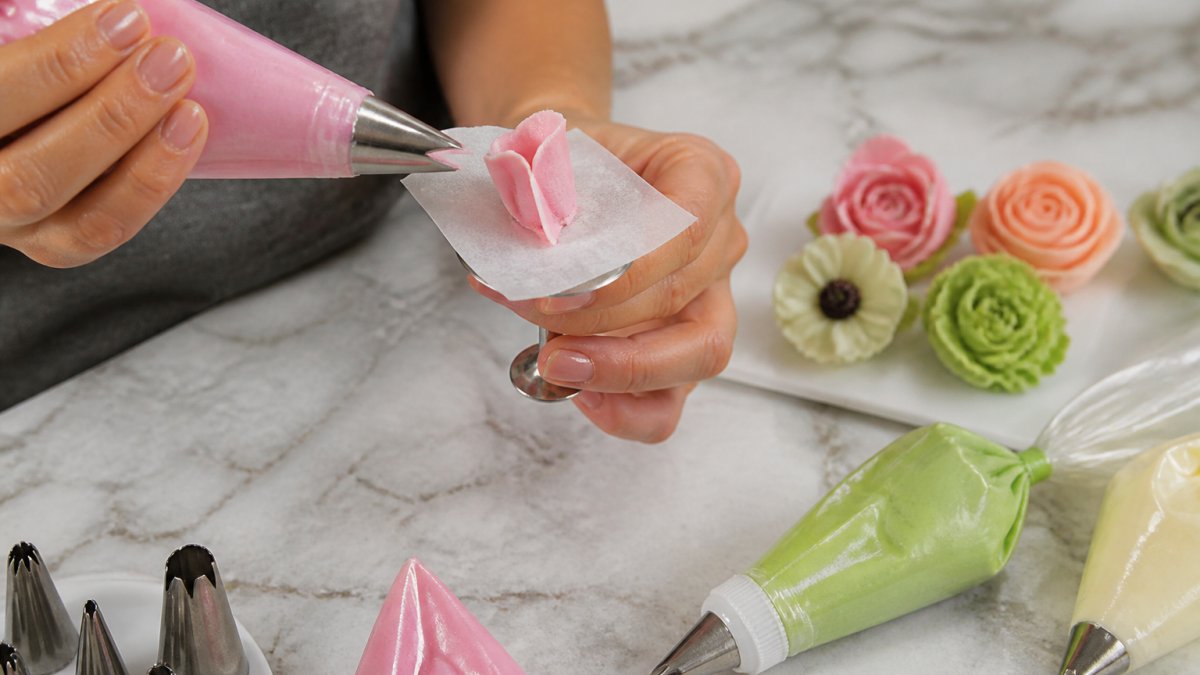
For this step, smaller bags give you more control. The Wilton 12-inch disposable decorating bags are a standard size option, and a Wilton decorating bag holder keeps prepared bags organized.

Watch out: Overfilling the bag pushes buttercream out the top and makes your petals uneven. Fill only two-thirds of the way.
How to Pipe Buttercream Roses with Layered Petals
Roses are the flower most people want to master, and they are simpler than they look. The trick is layering petals from the center outward, each one slightly wider than the last.
Start with a small cone of buttercream in the center of your parchment square. Then pipe a tight ring of petals around it, overlapping each petal slightly.
Three habits make the difference:
- Keep steady pressure. Stop squeezing before you pull away.
- Turn the nail, not your wrist. This keeps your piping angle consistent.
- Work fast. Buttercream softens as it sits in a warm bag.
Let each rose firm up on the parchment before you move it. If the petals start to droop, the buttercream is too warm. Chill the bag for a few minutes and start again.
Piping Classic Flower Varieties and Filler Leaves
Classic flowers give a cake its fullness. Drop flowers, rosettes and simple blossoms are quick to pipe and forgiving for beginners.
Pipe drop flowers with a single squeeze and release, keeping the tip close to the surface. For rosettes, start in the center and spiral outward.
When piping several varieties in one session, larger bags save refills. The Wilton 16-inch disposable decorating bags hold more buttercream for bigger batches of flowers and leaves.

Keep your shapes varied. A cake covered only in identical rosettes looks flat. Mix two or three flower types and add leaves between them.
How to Freeze Buttercream Flowers and Transfer Them to a Cake
Freezing is how you pipe flowers days ahead and still get a fresh-looking cake. Piped buttercream flowers freeze well on their parchment squares, and they firm up enough to handle easily.
Place the parchment squares on a tray and freeze until solid, usually a few hours. Then stack them in a sealed container with parchment between layers. They keep for several weeks.
When you are ready to use them:
- Pull the tray from the freezer and let the flowers soften for a few minutes.
- Lift each flower by the parchment edge.
- Press it gently onto the cake surface.
- Peel the parchment away slowly.
Watch out: Do not press a frozen flower hard into the cake. It will crack. Let it soften just enough to bend, then place it.
Arranging Piped Flowers on a Cake and Getting Them to the Table
Arrangement is where a good cake becomes a great one, and it is the step most tutorials skip.
Step 1: Start with a level, chilled base. A crumb-coated or fully frosted cake should chill for at least 30 minutes before you place flowers.
Step 2: Mark your anchor points. Decide where the three or five largest flowers will sit before you touch the cake. A common pattern is a loose triangle or a diagonal sweep rather than a perfect ring, because a symmetrical ring reads as mechanical. Press a light dot with a toothpick at each anchor point.
Step 4: Fill with medium blooms. Work around each large flower with medium flowers, keeping the gaps uneven.
Step 5: Add small blossoms and leaves last. Small star-tip blossoms and leaf tips fill the remaining gaps and soften the edges of the arrangement.
Step 6: Balance color and size. Step back from the cake every few flowers.
Chilling and setting. Once arranged, chill the cake for 20 to 30 minutes to set the buttercream before transport. This is not optional in warm weather. A set cake holds its flowers through a car ride; an unchilled one does not.
Transport. Carry the cake flat on a level surface, in a box or carrier that leaves at least 2 inches of clearance above the tallest flower. Keep it out of direct sun and away from a warm trunk. If you are driving more than 30 minutes in warm weather, chill the cake thoroughly first and use an insulated carrier with a frozen gel pack placed beside, not under, the cake.
Storage and serving. A decorated buttercream cake holds its shape in the refrigerator for 2 to 3 days. Beyond that, the buttercream can weep or pick up refrigerator odors. For serving, pull the cake out about 15 to 20 minutes ahead so the buttercream softens enough to cut cleanly. Cut with a hot, dry knife and wipe it between slices so the flowers stay intact on the remaining cake.
Stock Your Tool Kit at Jane's Cake and Baking Supply
Piping buttercream flowers takes practice, and the right tools make the learning curve shorter. A steady bag, a sharp tip and a flower nail will carry you through every bloom in this guide.
At Jane's Cake and Baking Supply, we stock the tips, bags and holders we recommend here, plus hands-on classes for bakers of every skill level.
Browse all baking and decorating supplies to build your kit in one stop, or stop in and we will help you pick the right tip for the flowers you want to pipe.
Frequently Asked Questions
What piping tips do you need to make buttercream flowers?
You can cover most classic blooms with a small set: a petal tip for roses and layered petals, a drop flower tip for rosettes and stars, and a small round tip for centers and buds. The Wilton 2D Decorating Tip ($3.50) handles drop flowers, rosettes, and swirls in one pass, which makes it a strong first buy. The Wilton 2D Decorating Tip works with standard decorating bags and a large coupler.
What buttercream is best for piping flowers?
American buttercream and Swiss meringue buttercream both hold piped shapes well when mixed to a medium-stiff consistency. It should hold a peak on the spatula without slumping but still flow smoothly through the tip. If it looks grainy or tears at the edges, it needs a few more seconds of mixing or a teaspoon of liquid. Buttercream that is too soft will let petals droop; too stiff and the petals crack.
Can you pipe buttercream flowers ahead of time and freeze them?
Yes. Pipe flowers onto parchment squares or a flower nail, then slide them onto a sheet pan and freeze until firm, about 30 to 60 minutes. Once solid, transfer them to an airtight container with parchment between layers and keep frozen until ready to use. To use, lift each flower by the parchment and press it gently onto a freshly piped dot of buttercream on the cake. Let it sit at room temperature for 15 to 20 minutes before serving.
Why are my buttercream flower petals breaking or drooping?
Breaking usually means the buttercream is too stiff or too cold, so it tears instead of flowing. Drooping means it is too warm or too thin. Let the bag sit in your hands for a minute to warm slightly, or chill the bowl for a few minutes if it is soft. Also check your bag pressure: squeezing too hard at the base flattens petals. Steady, even pressure as you lift and release builds a petal that holds its shape.
Ready to pipe your first rose? Order your tips and bags from Jane's Cake and Baking Supply and get the tools that make every petal hold its shape. Our stainless steel tips, disposable bags and bag holders are built to last, and our team is here to help you choose. Get started with Jane's Cake and Baking Supply and pipe flowers you are proud to serve.


