

Last Updated: October 28, 2026
Quick Summary
To smooth buttercream on a cake, chill the cake after applying a crumb coat, then apply the final layer and use a warmed scraper held at a flat angle with one continuous pass. Rotate the cake on a turntable and lift the tool cleanly off the edge to avoid ridges and drag marks.
- Chill the crumb coat until it is firm before applying the final layer.
- Hold the scraper closer to 45 degrees than 90 degrees against the cake.
- Warm the scraper blade in hot water, then dry it before each pass.
- Mix buttercream on the lowest speed for 1-2 minutes to remove air bubbles.
- Pull the offset spatula from the center toward the edge in one stroke.
Table of Contents
- What You Need Before You Start Smoothing Buttercream
- Preparing the Cake and Applying a Crumb Coat
- How to Smooth Buttercream with a Spatula on the Sides
- How to Use a Bench Scraper on a Cake for Sharp Edges
- Smoothing the Top Edge and Surface of the Cake
- How to Fix Air Bubbles in Buttercream and Other Common Problems
- Your Next Step: Practice on a Small Cake Before a Big Project
- Frequently Asked Questions
Smooth buttercream on a cake takes more than a good spatula. It takes the right tools, buttercream at the right consistency, and a cake that is chilled and ready. This guide walks through the process from start to finish. Many bakers find that the first attempt looks rough, but the steps below make a clean finish much easier to reach.
We will cover what you need, how to prepare the cake, and how to work the sides, the edges, and the top. We also cover the common problems, such as air bubbles, and how to fix them. Before you begin, it helps to know that buttercream smoothing is a skill that improves with practice. For guidance on food safety when storing frosted cakes, the USDA Food Safety and Inspection Service guidance on handling and storing perishable foods is a useful reference.
What You Need Before You Start Smoothing Buttercream
Good results start with the right tools. A turntable, a scraper, and an offset spatula cover most of the work. You do not need an expensive kit to begin.
Here is a short list of what most bakers use:
- A rotating cake turntable
- A smooth icing scraper
- A 9-inch offset spatula
- A bench scraper for sharp edges
- A bowl of hot water and a towel for warming tools
Choosing a Turntable, Scraper and Offset Spatula
A turntable lets you rotate the cake while you hold the tool steady. This keeps the motion even. The Ateco Aluminum Revolving Cake Stand has a 12-inch top and stainless steel ball bearings for smooth rotation. Its soft plastic cap on the base helps prevent sliding. Do not immerse it in water when cleaning.
For spreading, the Wilton 9-inch angled offset spatula is a practical choice. Its angled design helps keep your fingers out of the frosting, and it works for filling layers as well as smoothing sides and tops. Hand wash it in warm, soapy water before first use and after each use.
The Decopac Thermoplastic Icing Smoother is a wide plastic scraper for leveling frosting. The product listing describes bending it slightly and dragging it across the top and sides with a light touch. The NYCake Stainless Steel Scraper, Tall Smooth, is a double-sided scraper with two differently designed edges. Its listing says it is great for tall and standard-size cakes.
A turntable, scraper, and spatula are tools used in the steps below.
Getting the Right Buttercream Consistency
Consistency matters more than most beginners expect. Buttercream that is too soft will slide and tear. Buttercream that is too stiff will drag and leave ridges. Aim for a texture that holds its shape but still spreads easily.
Preparing the Cake and Applying a Crumb Coat
A common mistake is skipping the chill step. Frosting over a soft crumb coat often drags crumbs into the final coat.
How to Smooth Buttercream with a Spatula on the Sides
Once the sides look even, lift the scraper away cleanly at the top edge. Wiping the scraper between passes keeps the surface free of buildup. For a larger plain-edge side scraper for tall surfaces, see the PME Plain Edge Side Scraper. If the scraper drags, warm it briefly in hot water, wipe it dry, and try again.
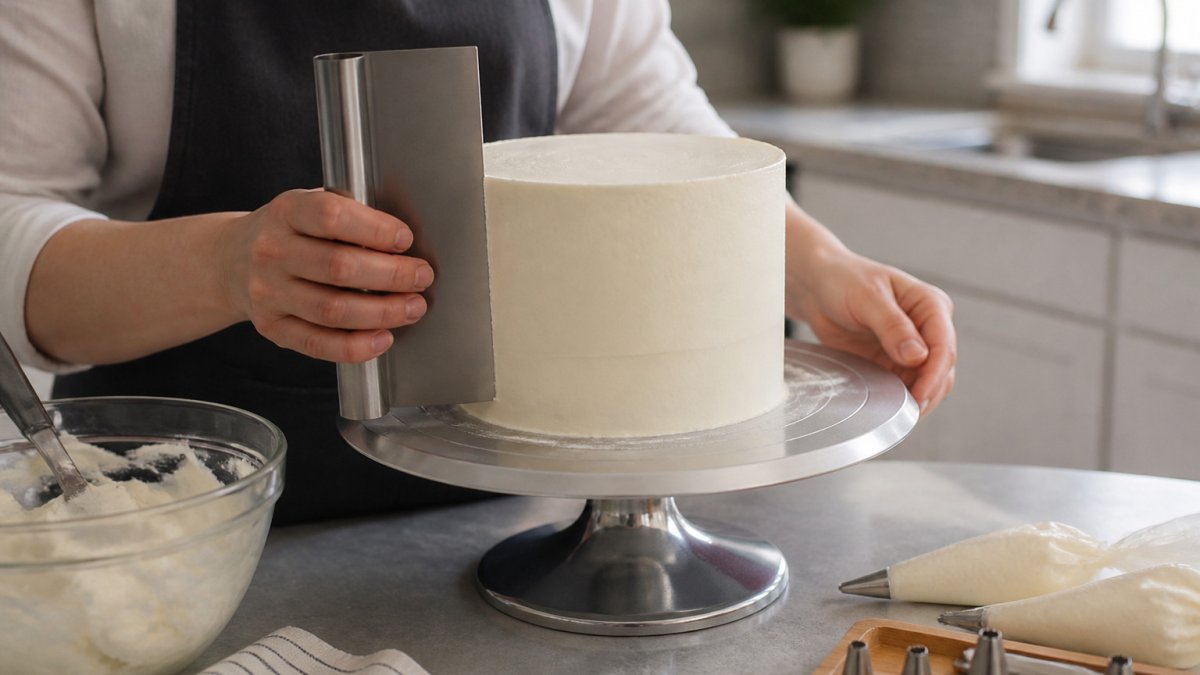
How to Use a Bench Scraper on a Cake for Sharp Edges
Clean the scraper between passes so that frosting does not build up on the blade. For a stainless steel option sized for sharp edges, see the Ateco Stainless Steel Bench Scraper. Sharp edges look best when the frosting is well chilled.
Wilton 9" Angled (Offset) Spatula →
Smoothing the Top Edge and Surface of the Cake
For a silky surface, use a smoother held at a slight angle. Move it across the top in one direction, then lift it cleanly off the edge. Rough edges usually come from lifting the tool too early or pressing too hard.
How to Fix Air Bubbles in Buttercream and Other Common Problems
Most smoothing defects come from one of three sources: air trapped in the buttercream, a temperature mismatch between the cake and the frosting, or a tool held at the wrong angle. Once you know which source you are dealing with, the fix is usually quick.
Air bubbles and pockets
Air gets into buttercream when it is mixed too fast, when powdered sugar is dumped in rather than added gradually, or when the frosting is over-whipped after chilling. To remove it, mix on the lowest speed for 1-2 minutes after the buttercream is fully combined, then let it rest for a few minutes so bubbles can rise. Tapping the bowl on the counter helps, and so does pressing a spatula against the surface and dragging it slowly to pop the larger pockets. For a final layer, a warm scraper pass (see below) closes small surface bubbles.
Ridges and drag marks
Ridges are the signature of a scraper held at too sharp an angle or a buttercream that is too stiff. Hold the scraper flatter against the cake, closer to 45 degrees than 90, and warm the blade briefly in hot water, then dry it. If the buttercream itself is stiff, loosen it with a few drops of liquid and mix on low before the next pass.
Bulges and uneven sides
Bulges usually mean the buttercream is warmer on the outside than the inside, or that the cake was not level to begin with. Chill the cake for 15-20 minutes, then make one firm, continuous pass with a tall metal scraper held straight up. If the cake itself is domed, trim it before the crumb coat; no amount of smoothing will fix a sloped top.
Crumbs in the final coat
Crumbs in the final layer almost always trace back to a crumb coat that was too soft or skipped. The fix is to chill the crumb coat until it is firm to the touch, then apply the final layer with a clean spatula and light pressure. If a few crumbs still appear, pick them out with the tip of a knife rather than trying to smooth over them.
A ragged top edge
A ragged top edge comes from lifting the tool too early or pressing too hard at the rim. Fill any gap with a small amount of buttercream, then pull the offset spatula from the center toward the edge in one stroke, lifting cleanly at the end. For a crisp corner, use a bench scraper held upright and drag it toward the top edge while the turntable turns.
A repair sequence that works
A quick reference for the most common defects:
| Problem | Likely cause | Fix |
|---|---|---|
| Air bubbles | Mixed too fast or over-whipped | Mix on low, rest, tap the bowl |
| Ridges | Scraper angle too sharp or buttercream too stiff | Hold flatter, warm the blade, loosen the buttercream |
| Bulges | Warm outer layer or unlevel cake | Chill, level the cake, one firm pass |
| Crumbs | Soft or missing crumb coat | Chill the crumb coat, use a clean spatula |
| Ragged top edge | Tool lifted too early or pressed too hard | Fill, pull in one stroke, lift cleanly |
Your Next Step: Practice on a Small Cake Before a Big Project
Ready to start? Browse the Wilton 9-inch offset spatula, the Ateco Aluminum Revolving Cake Stand, and the NYCake Stainless Steel Scraper at Jane's Cake and Baking Supply, and order what you need for your next project.
Frequently Asked Questions
How do you get the smoothest buttercream on a cake?
Start with buttercream that is soft but not runny, around the consistency of thick peanut butter. Mix on low speed after whipping to release air bubbles, then apply a generous crumb coat and chill the cake for 20 to 30 minutes. For the final coat, spread a thick, even layer, then use a warm, dry bench scraper or cake smoother held steady with light pressure while rotating the turntable slowly. Wipe the scraper clean between passes, and dip it in hot water and dry it only when the surface drags.
Should you chill a cake before smoothing buttercream?
Yes. A chilled crumb coat sets firm, so it does not pull up crumbs when you apply the final coat. Chill the cake for about 20 to 30 minutes until the frosting feels firm to the touch. Keep the final coat at room temperature while you work, since cold buttercream tends to tear and show ridges when scraped.
How do you fix air bubbles in buttercream?
Before frosting, beat the buttercream on low speed for two to three minutes to push out trapped air. If bubbles still appear on the cake, gently press the tip of an offset spatula over the spot to smooth it, then drag a warm scraper across the area. For larger pockets, scrape the frosting off that section, re-spread a fresh layer and smooth again. Store leftover buttercream in an airtight container to keep it from picking up more air.
Why is my buttercream grainy or bumpy?
Grainy buttercream usually comes from butter that was too cold or sugar that did not fully dissolve. Let butter soften to room temperature and beat it well before adding sugar. Bumpy or uneven frosting often means the layer was too thin or the scraper was held at an angle. Apply more frosting, then smooth with steady, light pressure and a single, continuous pass rather than repeated back-and-forth strokes.


