

Last Updated: November 22, 2026
Quick Summary
Round cake pans build tall layer cakes, while rectangular cake pans cover sheet cakes, brownies, and bars. For new bakers, one of each is a sensible starting point before buying anything else. Round pans stack into tiers, and rectangular pans feed a crowd from a single batch.
- Heavy-gauge aluminum heats fast and evenly, which is why commercial kitchens use it.
- Fill pans no more than two-thirds full so batter has room to rise without spilling.
- A 9" x 13" pan handles sheet cakes, brownies, bar cookies, and slab pies in one batch.
- Hand wash coated pans with mild soap and a soft sponge, and skip the dishwasher.
- The USA Pans line is made in the USA and carries a lifetime warranty.
Table of Contents
- Round vs Rectangular Cake Pans: The Quick Comparison
- Cake Pan Materials: Aluminum, Aluminized Steel and Nonstick Coatings
- Cake Pan Sizes and How to Scale a Recipe
- Rectangular Cake Pans for Sheet Cakes, Brownies and Bars
- Cake Pans With Lids for Transport and Storage
- Care, Coating Safety and How Long a Pan Lasts
- Order Your Cake Pans From Jane's Cake and Baking Supply
- Frequently Asked Questions
Round vs Rectangular Cake Pans: The Quick Comparison
The short answer: round cake pans build tall layer cakes, rectangular cake pans cover sheet cakes, brownies, and bars. For new bakers, one of each is a sensible starting point before buying anything else. Round pans stack into tiers and give you clean, even slices. Rectangular pans feed a crowd from a single batch and travel better. That's the whole trade-off in two sentences,
Here is the practical breakdown:
| Factor | Round Pans | Rectangular Pans |
|---|---|---|
| Best for | Layer cakes, tiered cakes, wedding cakes | Sheet cakes, brownies, bars, traybakes |
| Typical sizes | 6", 8", 9", 12" diameter | 9" x 13", 13" x 18" half sheet |
| Serving style | Sliced wedges, stacked layers | Cut squares, single-layer frosting |
| Storage | Stacks compactly | Takes up more shelf space |
| Skill fit | Decorators building height | Home bakers feeding groups |
If you want round layer cakes, browse our 8-inch round cake pan to see the size most layer recipes are written for. The honest limitation of round pans: you need two or three matching pans to bake a full layer cake in one go, and mismatched diameters throw off stacking. Rectangular pans have the opposite problem. One pan does the job, but you can't build height with it.
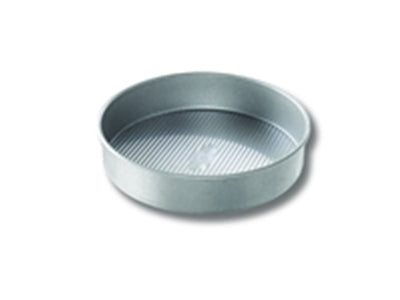
Cake Pan Materials: Aluminum, Aluminized Steel and Nonstick Coatings
Heavy-gauge aluminum heats fast and evenly, which is why commercial kitchens use it. Aluminized steel adds a steel core for strength, so it resists warping and denting over years of oven use. Nonstick coatings make release easier, but they wear with harsh washing.
Material-by-material comparison
| Material | Heat response | Browning | Durability | Release | Best for |
|---|---|---|---|---|---|
| Bare aluminum | Fast, even | Pale, even crust | Dents; discolors | Needs greasing and flouring | Layer cakes, sponge |
| Aluminized steel | Moderate, even | Even, slightly deeper than aluminum | Resists warping and denting | Needs greasing or coating | Weekly baking, sheet cakes |
| Carbon steel | Fast, responsive | Deep, crisp edges | Very durable; can rust | Seasons over time | Brownies, bars, dense cakes |
| Cast aluminum | Slow to heat, holds heat | Deep, even browning | Very durable; can chip | Often coated | Bundt, decorative shapes |
| Glass | Slow, uneven | Pale sides, dark bottom | Chips; thermal shock risk | Good once greased | Casseroles, coffee cakes |
| Silicone | Fast, flexible | Little browning | Stains; tears | Excellent | Novelty shapes, small bakes |
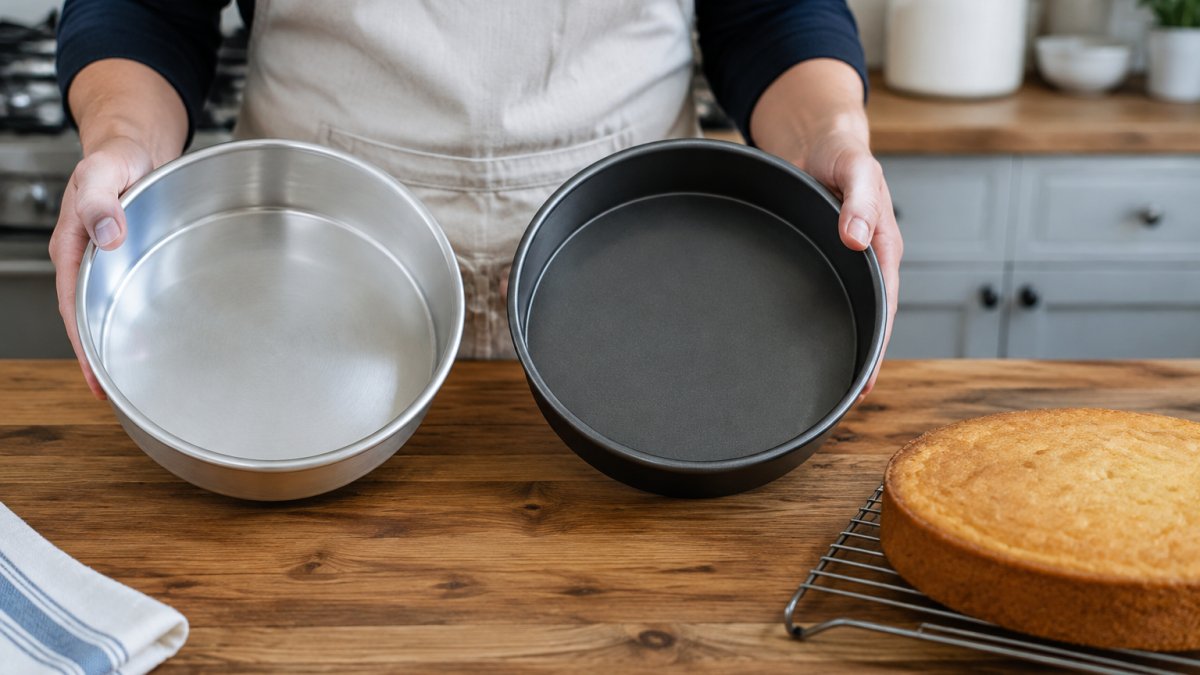
The difference shows up in browning. Light-colored metal reflects heat and produces a paler, more even crust. Dark nonstick surfaces absorb heat, so edges brown faster. If your cakes come out with dark rims and a raw center, the pan color is often the culprit, not your oven.
The USA Pans line uses Americoat, a silicone coating that does not contain PTFEs or PFOAs, and it is not recommended to exceed 450 degrees F. Keeping within that temperature matters if you bake hot or often. A common mistake is running coated pans through the dishwasher.
Watch out: carbon steel and bare aluminum can react with acidic batters and leave a metallic taste or gray tint, so grease them well and avoid long storage of acidic cakes in the pan.
Cake Pan Sizes and How to Scale a Recipe
Pan size changes baking time, not just volume. A recipe written for two 8-inch rounds will not bake the same in a 9-inch pan, and it certainly won't fit a 9" x 13" rectangle without adjustment. Most guides stop at listing pan dimensions and leave the conversion math to the reader. Here is a working chart with two rules that make it usable.
Surface area and volume by pan size
| Pan | Surface area | Approx. batter volume (2/3 full) | Common use |
|---|---|---|---|
| 6" round (2" deep) | ~28 sq in | ~2 cups | Small batch, smash cakes |
| 8" round (2" deep) | ~50 sq in | ~4 cups | Standard two-layer cake |
| 9" round (2" deep) | ~64 sq in | ~5 cups | Shallower layers, shorter bake |
| 9" x 13" rectangular | ~117 sq in | ~10 cups | Sheet cakes, brownies, bars |
| 13" x 18" half sheet | ~234 sq in | ~20 cups | Crowd-size batches, jelly rolls |
| 10-cup Bundt | n/a (fluted) | ~10 cups | Dense cakes, pound cakes |
Approx. batter volume (2/3 full)
Rule 1: Match surface area, then check depth. Going from two 8-inch rounds (100 sq in total) to one 9" x 13" pan (117 sq in) is close to a straight swap for many recipes; the slightly larger area means a marginally thinner layer and a slightly shorter bake. Going from a 9-inch round (64 sq in) to a half sheet (234 sq in) means roughly quadrupling the batter, not doubling it.
Rule 2: Adjust for depth, not just width. A 9" x 13" pan that is 2 inches deep holds about 10 cups at two-thirds full; a 9" x 13" pan that is 3 inches deep holds closer to 15 cups. Two pans with the same footprint can behave very differently. If your pan is deeper than the recipe assumes, the center sets later and the edges brown more; drop the oven temperature by 25 degrees F and extend the bake, checking every 5 minutes after the original time.
Worked conversions
- Two 8-inch rounds to one 9" x 13": multiply batter by about 1.15, or use the recipe as written and accept a slightly thinner cake. This is the most common swap home bakers ask about, and it usually works without any math.
- One 9-inch round to two 6-inch rounds: two 6-inch rounds total about 56 sq in versus 64 sq in for the 9-inch, so the recipe fits with a little batter left over for cupcakes.
- 9" x 13" to 13" x 18" half sheet: double the batter. A half sheet is about twice the area, and the thinner layer will bake in roughly 60 to 75 percent of the original time.
- Round to Bundt: a 10-cup Bundt holds roughly the same batter as a 9" x 13" pan, but the fluted shape and central tube change how heat reaches the center. Expect a longer bake and a denser crumb.
Fill pans no more than two-thirds full so batter has room to rise without spilling onto the oven floor. Watch out: if you scale a recipe up without adjusting leavening, a deep pan can leave the center raw while the edges overbake; keep the leavening proportional to the flour, not to the pan volume.
Rectangular Cake Pans for Sheet Cakes, Brownies and Bars
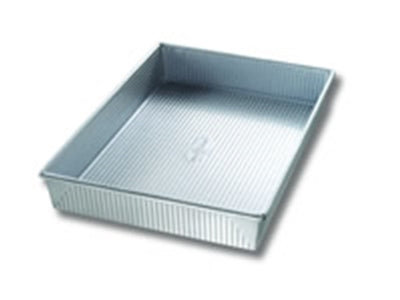
Rectangular cake pans are the workhorses of home baking. A 9" x 13" pan handles sheet cakes, brownies, bar cookies, and slab pies, and it fits most standard ovens without crowding. When a sports team needs dessert for a party, this is the pan that gets it done in one batch.
A rectangular 9x13 pan is the size most boxed mixes and bar recipes are written for, so you can bake without converting anything. For bigger jobs, a 13x18 half sheet pan covers sheet cakes for a crowd, large batches of bars, and jelly roll-style bakes.
Watch out: glass and dark metal rectangular pans run hot. Reduce the oven temperature slightly and start checking early, or you'll get a dark crust before the center sets.
Cake Pans With Lids for Transport and Storage
A lid turns a cake pan into a carrier. If you bake for potlucks, bake sales, or family events, a pan with a cover means no foil tenting, no smeared frosting, and no crumbs in the car.
The Wilton Perfect Results nonstick 13 x 9 oblong pan with cover pairs a standard rectangular pan with a fitted lid, so the cake cools, travels, and stores in the same vessel. That's the practical advantage most buyers overlook. You're not paying for the lid; you're paying to skip the step where the cake slides off a plate in the back seat.
For layer cakes, lids are less useful. Round pans with covers exist, but tall frosted layers usually outgrow them.
Care, Coating Safety and How Long a Pan Lasts
A well-cared-for pan lasts decades. The rules are short. Hand wash coated pans with mild soap and a soft sponge. Skip the dishwasher on any nonstick surface. Dry fully before stacking, and nest pans with a paper towel between them to prevent scratches.
Coating safety comes down to condition. A scratched or peeling nonstick surface should be retired, because the coating is what makes release work. Uncoated aluminum and aluminized steel have no coating to fail, which is why commercial bakers favor them. They may discolor over time, but they keep baking evenly. Our guide to keeping cake layers from sticking covers greasing, flouring, and pan prep in more detail if release is your recurring problem.
How long a pan lasts depends on heat and handling. Avoid sudden temperature changes, like moving a hot pan onto a cold stone counter, because thermal shock warps thin metal. The USA Pans line is made in the USA and carries a lifetime warranty.
Order Your Cake Pans From Jane's Cake and Baking Supply
Stocking a kitchen with the right cake pans for baking takes one good round pan and one good rectangular pan. Everything else is refinement.
The real challenge isn't choosing between round and rectangular. It's building a set that covers layer cakes, sheet cakes, and everything between without buying pans you'll never use. Jane's Cake and Baking Supply carries aluminized steel round pans in 8-inch and 9-inch sizes, a 9" x 13" rectangular pan, and a 12-inch round pan, with a lifetime warranty on the USA Pans line. We are licensed, bonded, and insured. Get started with Jane's Cake and Baking Supply and bake your next layer cake or sheet cake in a pan built to last.
Frequently Asked Questions
Are cake pans and baking pans the same thing?
Mostly, yes. A cake pan is a type of baking pan, but the term baking pan also covers sheet pans, loaf pans, muffin tins and roasting pans. When a recipe says cake pan, it usually means a round pan with straight, 2-inch sides, such as the USA Pans 8" x 2" Round Cake Pan. Check the recipe's stated dimensions before you substitute, because depth and diameter both affect baking time.
What is the best material for a cake pan?
Aluminized steel and commercial-grade aluminum give the most even heat distribution and hold up longest. Aluminized steel, used in USA Pans, resists warping and denting and is coated with a silicone finish that releases cakes cleanly. The Magic Line 9 x 2 has straight sides and sharp corners and is made in the USA. Glass and dark nonstick pans brown faster, so reduce the oven temperature by about 25 degrees F when you use them.
Are aluminum cake pans better than nonstick pans?
They solve different problems. Bare aluminum conducts heat quickly and produces level, evenly browned layers, but you must grease and flour it every time. Nonstick coatings release delicate cakes and cut cleanup time, yet they scratch and degrade if washed in the dishwasher or heated above the manufacturer's limit. USA Pans Americoat coating, for example, should not exceed 450 degrees F. Many bakers keep one of each and choose by recipe.
What size cake pan should I use for a recipe?
Match the pan the recipe names. If you swap a 9-inch pan for an 8-inch one, the batter will be deeper and needs a longer, slower bake. Fill pans no more than two-thirds full and keep the oven temperature the same unless you switch to glass or dark metal.
Do dark cake pans bake differently from light-colored pans?
Yes. Dark and nonstick pans absorb more heat, so crusts brown sooner and edges can overbake before the center sets. Light-colored aluminum and aluminized steel reflect heat and produce a paler, more even crumb. When you move a recipe from a light pan to a dark one, drop the oven temperature by 25 degrees F and start checking for doneness five minutes early.


